Cobot welding
Cobot welding your welders teach by hand
Teach the weld by hand, pick the joint from the library, and weld. Built for shops that have welders, not robot programmers.
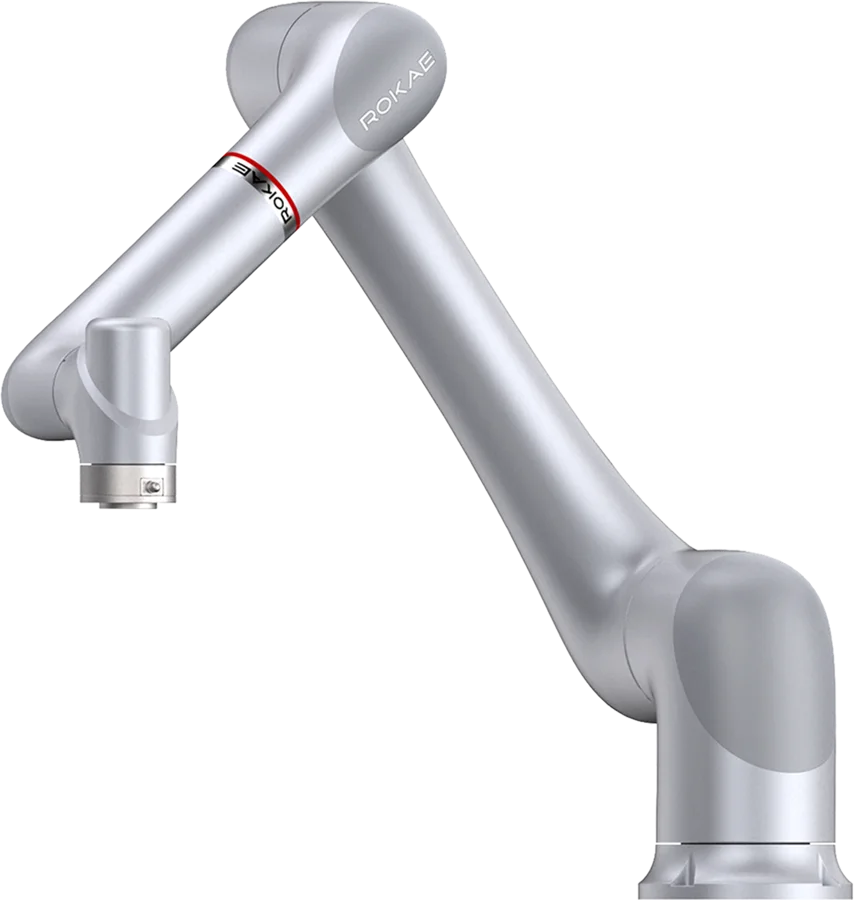
How it works
- 01
Hand-guide the torch to the start and end of the seam.
- 02
Choose plate thickness and joint type. The library fills in starting weld settings you can adjust.
- 03
Dry-run the path, then weld.
- 04
Save the program and reuse it on the next part by re-teaching a few points.
Power sources
Compatible with welding power sources from:
- Lincoln Electric
- Miller
- Panasonic
- EWM
- Fronius
Other brands connect through an analog interface. Tell us which welder and model you run, and we’ll confirm the setup before you buy.
Brand names are trademarks of their owners. Compatibility does not imply endorsement.
Weld features
- Multi-layer, multi-pass welding for thick plate.
- Weave patterns (triangle, sine and arc) for vertical and grooved joints.
- Stitch (intermittent) welding.
- Gas check, wire inch and retract, and tack welds from the same screen.
- Arc start and end settings, with automatic restart after an arc break.
- Live current, voltage and travel speed while it welds.
Features as documented by ROKAE Robotics.
Robots for welding
| Model | Type | Payload (kg) | Reach (mm) | Best for |
|---|---|---|---|---|
| xMate CR7-7/0.98C | Cobot | 7 | 988 | Weld carts, small parts |
| xMate CR12-12/1.4C | Cobot | 12 | 1,434 | Larger parts, longer seams |
| NB12h | Industrial, hollow wrist | 10–15 | 1,473–1,648 | Fixed cells, higher duty |
| NB25h-12/2.2 | Industrial, hollow wrist | 12 | 2,258 | Large weldments, long reach |
The NB12h and NB25h run on three-phase power. US power requirements on request.
Built for the shop floor
- Path accuracy better than 1 mm (0.04 in), with vibration suppression that cuts torch-tip jitter by more than 80%.
- IP67-rated arm body on the CR cobots.
- ±360° on every joint of the CR7 and CR12, for awkward torch angles.
- A torque sensor in every joint, so the arm follows your hand with about 1 N of force.
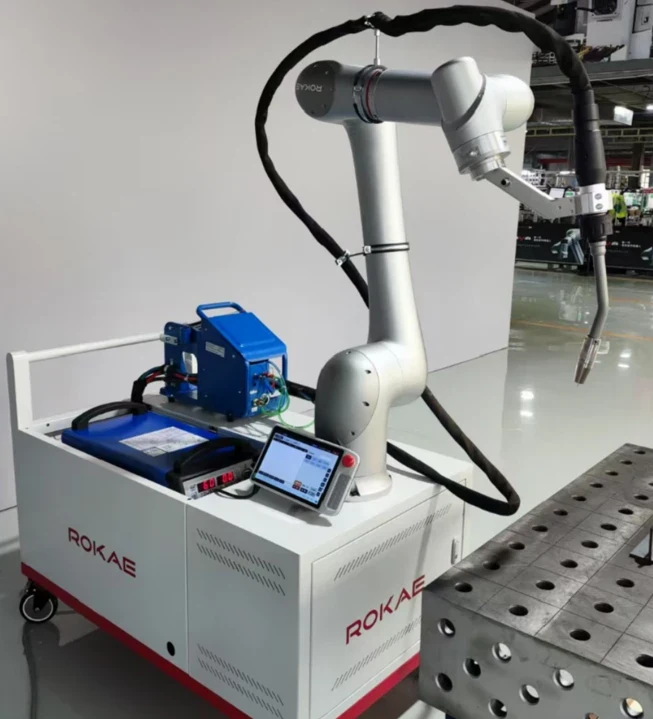
- Mounts on a magnetic base, a mobile cart or a linear rail.
Figures reported by ROKAE Robotics for the xMate cobots. Results depend on part, process and cell design.
Where it fits
Hand teaching pays off where batches are small and part types change often.
- Structural steel
- Shipbuilding
- Machinery
- Auto parts
- Power plant work
- Pressure vessels
- Pipe
- Hardware
- Sheet steel
Send us your parts
Tell us what you weld, and we’ll set up a sample program on your own parts.